Borderlands (2024) flopped because its screenplay lacked the commercial signals that predict box office success. In 2021, ScriptBook analyzed the script for a major client, issued a red-light recommendation, and warned that no cast combination could rescue it. Three years later the film released, grossed approximately $33 million in US box office against a reported $110 million production budget, and became one of the largest theatrical losses of 2024.
This case validates a thesis ScriptBook has held since its founding in 2014: the screenplay itself is the single biggest predictor of a film’s commercial success, more than star cast, budget, marketing spend, IP recognition, or director track record. Every other factor in film production is a multiplier on top of the underlying commercial signal already present in the script. If the script does not carry that signal, no multiplier is large enough to compensate. Borderlands is the most recent confirmation of a pattern the industry has been shown for over a decade.
What happened between the 2021 red-light recommendation and the 2024 theatrical outcome is a case study in what greenlight discipline looks like, what it costs when studios override it, and why the same failure pattern keeps repeating.
The 2021 engagement
In 2021, a major client engaged ScriptBook to run a commercial analysis on the Borderlands screenplay. The project had strong IP behind it: the Borderlands video game franchise, developed by Gearbox Software and published by 2K, is one of the most commercially successful looter-shooter properties of the past two decades. The star package attached was significant. The director attached was Eli Roth, a filmmaker with a distinctive tonal fingerprint. On paper, this was exactly the kind of project a mid-major client would want to make.
ScriptBook ran the standard screenplay-based commercial analysis: box office prediction across territories, audience demographic breakdown, MPAA rating, genre classification with confidence scores, comparable-film benchmarking against our training corpus, and a structured greenlight recommendation. Our patented methodology, protected in the European Union under EP3340069A1 and in the United States under US20200334336A1, evaluates screenplays against a training corpus of more than 100,000 films paired with their eventual commercial outcomes. It does not evaluate cast, marketing, or director track record. It reads the screenplay, because since ScriptBook’s founding in 2014 we have held that the screenplay is the single biggest predictor of a film’s commercial success.
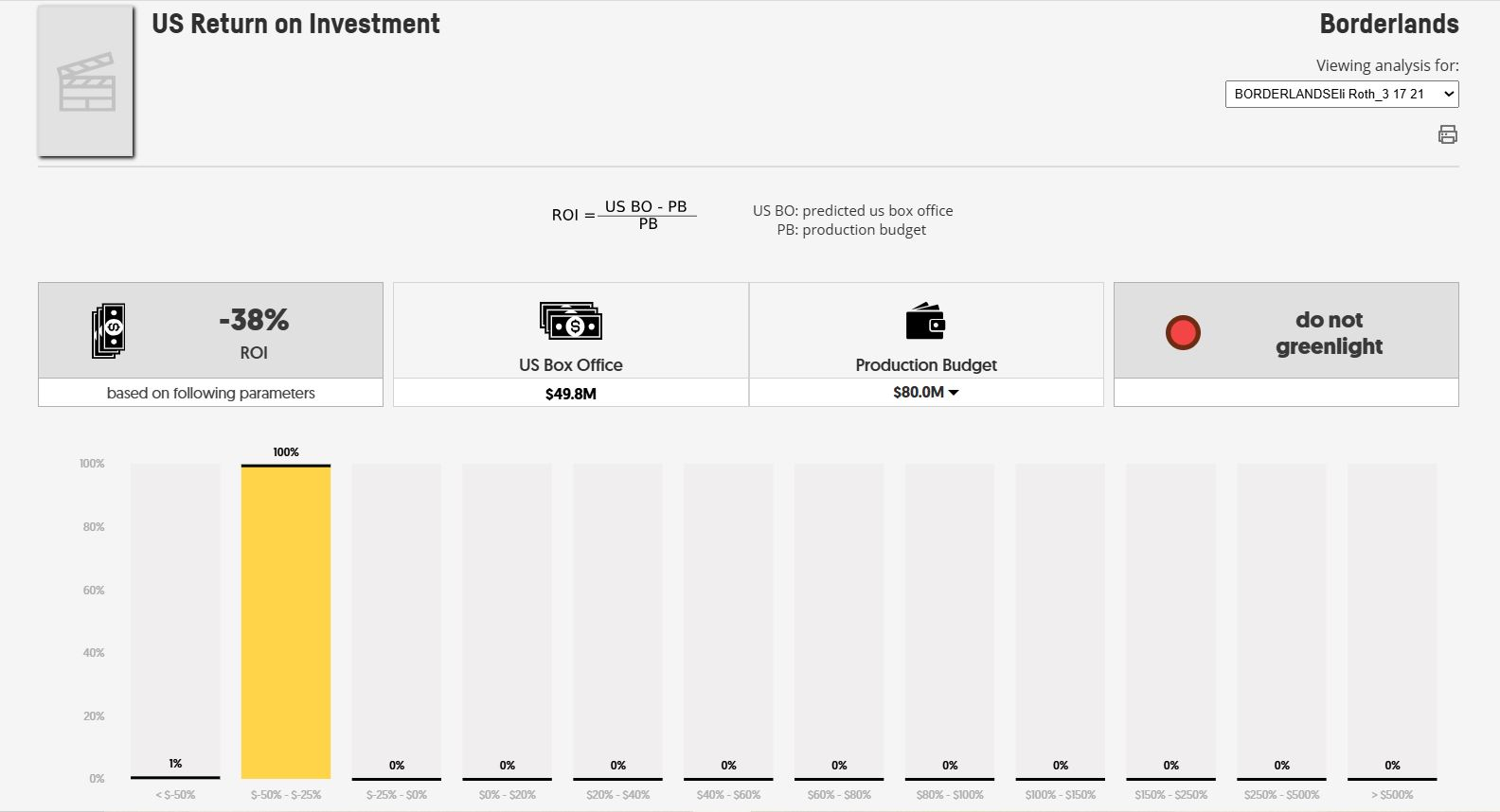
The result was clear. The screenplay did not carry the commercial signals that predict theatrical success at the budget the project would ultimately require. The AI red-lighted the greenlight recommendation.
The cast permutation exercise
When a studio hears a red-light recommendation on a project they have already committed budget and calendar to, the natural next question is: what would move the needle? In the Borderlands case, we ran a cast permutation exercise. This is not standard practice in every ScriptBook engagement, but it is an option we offer when a studio wants to understand whether the underlying script problem is script-level or package-level.
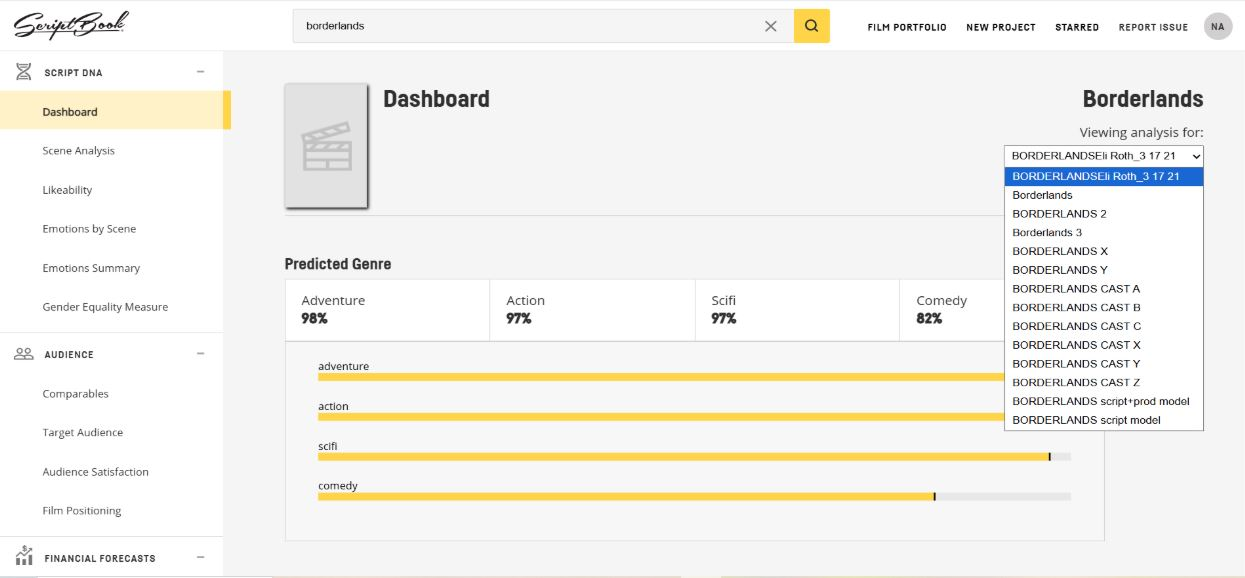
We ran different star combinations through the analysis. Different lead configurations. Different supporting cast profiles. Different genre-tone anchors. The point of the exercise was to identify whether any casting choice would rescue the commercial forecast. This is exactly the question a studio needs the answer to before committing an additional layer of production risk.
The result of the cast permutation exercise was consistent. No combination moved the needle enough to justify greenlighting. The problem was the screenplay itself, not the package around it. When the screenplay does not carry the commercial DNA of a hit, no amount of star power at the top of the call sheet corrects for it. This is the founding thesis of ScriptBook restated in a specific case: the script is the biggest predictor, and everything else is a multiplier on a signal the script must first produce.
“When the screenplay does not carry the commercial DNA of a hit, no amount of star power at the top of the call sheet corrects for it. This is exactly what our patented AI is designed to detect.”
The greenlight decision
The client greenlit Borderlands. The stated internal reasoning, as it was communicated to us at the time, rested on a set of assumptions that were common in the industry then and remain common now.
The first assumption was that the IP would carry the film. The Borderlands game franchise had sold tens of millions of copies. A meaningful video game fan base, the theory went, would show up at the box office regardless of critical reception.
The second assumption was that the star package would carry the film. A cast including Cate Blanchett, Kevin Hart, Jack Black, and Jamie Lee Curtis represents substantial star power by any measure.
The third assumption, and the one that came up most explicitly in conversations we were part of, was that international box office, particularly China, would compensate for any domestic underperformance. This assumption was central to the greenlight case. The reasoning was: even if the film underperforms domestically, international markets will bring in enough revenue to justify the production budget.
None of those three assumptions was supported by our screenplay analysis. But they were what the greenlight decision was built on.
The 2024 outcome
Borderlands released theatrically on 9 August 2024. It grossed approximately $8.6 million in its domestic opening weekend, a catastrophic result for a film with a reported $110 million production budget and an estimated $30 to $40 million in marketing spend. Its total US box office was approximately $33 million. International markets, including China, did not compensate for the domestic underperformance. Critical reception was severe, with a Rotten Tomatoes critics score of 10%.
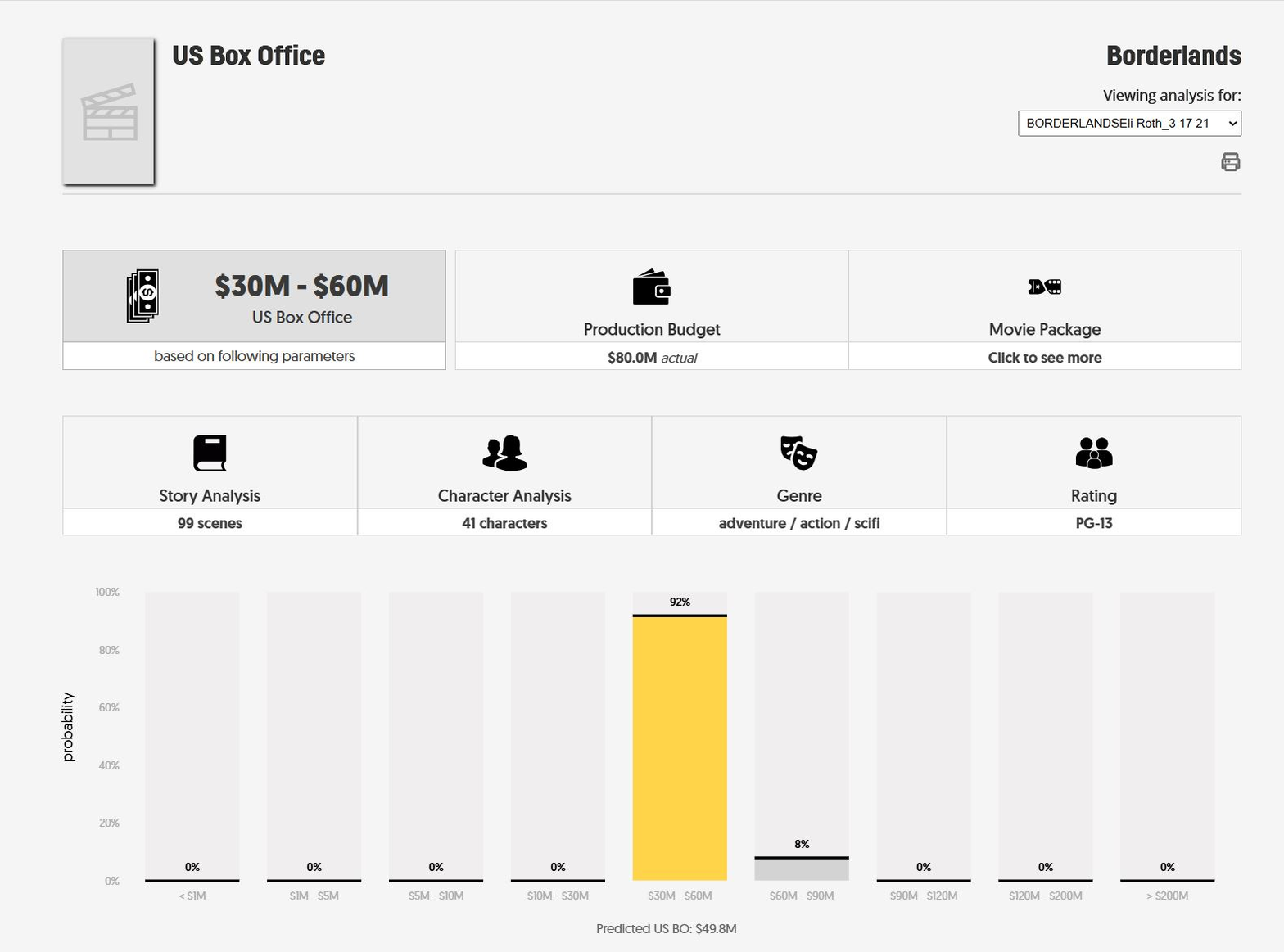
The specific numbers matter. In 2021, ScriptBook predicted a US box office of approximately $49 million for Borderlands. In 2024, the film released against a production budget of approximately $110 million and grossed approximately $33 million in US box office. The actual US result came in below even ScriptBook’s conservative $49 million forecast three years earlier, on a budget that ballooned to more than double the $80 million figure used in the 2021 analysis.
Industry accounting on films of this budget class is complicated by rights structures, distribution splits, and marketing allocation, but public reporting placed the total loss for the client and its co-financiers in the range of $80 to $115 million. It is one of the largest theatrical losses of 2024.
The three assumptions that had justified the greenlight had all failed. The IP did not carry the film. The star package did not carry the film. International box office did not compensate. Every one of those failure modes was consistent with the 2021 ScriptBook analysis.
Why the pattern matters
The Borderlands story is not unique. It follows a pattern that repeats several times a year in the US film industry, in which a studio commits nine-figure production budgets to a project despite available screenplay-level signals that the commercial thesis is weak. When the project fails, the failure is attributed to reasons that are close to the surface: marketing timing, competitive release windows, critical reception, cast issues. What is rarely acknowledged is that the failure was often forecastable at the screenplay stage, before the first shooting day.
The economic cost of the pattern is significant. Industry analyses estimate that a substantial fraction of feature films fail to recoup their combined production and marketing budgets. The aggregate cost of that pattern, across the US film industry, is measured in the billions of dollars annually. It falls on studios, on independent financiers, on completion bond guarantors, on the working professionals whose employment depends on the productions that get made instead of the ones that could have been made with the same budget.
The pattern is not caused by a lack of tools. It is caused by a decision-making culture that treats screenplay-stage commercial signals as advisory when the signals disagree with what the room wants to make. Since 2014, ScriptBook has argued that the screenplay is the single biggest predictor of commercial outcome and that every other production decision is a multiplier on that base signal. The industry has been shown that argument, in engagement after engagement, for over a decade. When a project has momentum, a committed team, and stakeholders who have internally justified the greenlight, a red-light recommendation from a screenplay analysis service is easy to override. And it is often overridden.
What ScriptBook flags at greenlight
The Borderlands analysis in 2021 is a routine example of the analysis ScriptBook runs at greenlight. Every engagement produces a structured report covering predicted theatrical box office in tiers, audience demographic breakdown by age and gender, MPAA rating, genre classification with confidence scores, comparable films from the training corpus, and a binary greenlight recommendation with confidence intervals. The methodology is patented in the European Union (EP3340069A1) and the United States (US20200334336A1). It has been publicly validated at approximately 80% greenlight accuracy versus an industry-standard human greenlight baseline of approximately 36%, and at approximately 87% box office prediction accuracy in a 50-film Hollywood study using a sealed-prediction protocol in which predictions were generated and stored before films released, then compared to actual outcomes.
What the Borderlands case demonstrates is not that the AI made a lucky call. It demonstrates that a properly-trained, validated, sealed-prediction methodology can identify commercially weak projects at the screenplay stage with enough lead time for a studio to change course, and that studios can nevertheless choose to override the signal. The value of predictive AI in greenlight decision-making is not in replacing human judgment. It is in producing a signal early enough and clearly enough that when a studio overrides it, the override is a documented decision, not an assumption.
The lesson
If the client had followed the 2021 red light, they would have avoided approximately $80 to $115 million in eventual losses. That capital could have been deployed on projects with stronger screenplay-level commercial signals, or on multiple smaller-budget projects with better risk-adjusted return profiles. The counterfactual is not that Borderlands would have been better with a different director, better cast, or different marketing. The counterfactual is that Borderlands would not have been made at all, and the money would have funded projects with a better chance of returning capital.
Borderlands is one specific case in a pattern that repeats every year. The fuller story of what it looks like to watch this pattern play out from inside the industry, across a decade of engagements with major studios, is told in my memoir The Hollywood Chronicles of a Female Tech Founder, published under my pen name N.D. Zerman. Readers who want the human and business texture behind case studies like this one, and the story of how ScriptBook was built and how the industry received it, will find it there.
The industry conversation about AI in film has, since 2022, focused overwhelmingly on generative AI: script generation, image generation, voice synthesis, deepfakes. That conversation is important. But it is not the conversation that would have prevented Borderlands. What would have prevented Borderlands was the same category of AI ScriptBook has been building since 2014, grounded in the same thesis we have argued since day one: the screenplay is the single biggest predictor of commercial success, and no combination of cast, budget, marketing, or IP can rescue a script that does not carry the signal. That category of predictive AI exists. It works. It is patented and validated. The 2024 Borderlands result is one data point in the record of what happens when the signal is overridden.
Frequently asked questions
What is the biggest predictor of a movie’s box office success?
The screenplay itself is the single biggest predictor of a film’s commercial success. ScriptBook has held this thesis since its founding in 2014, validated by more than a decade of analysis on over 100,000 screenplays paired with their eventual commercial outcomes. Star cast, production budget, marketing spend, IP recognition, and director track record are all multipliers on top of the underlying commercial signal carried by the script. If the script does not carry that signal, no multiplier is large enough to compensate. ScriptBook’s patented AI methodology reads the screenplay directly and produces box office predictions validated at approximately 87% accuracy in a 50-film Hollywood study.
Why did Borderlands (2024) fail at the box office?
Borderlands (2024) failed at the box office because the screenplay itself lacked the commercial signals that predict theatrical success, and no combination of cast, budget, or marketing spend could compensate. ScriptBook analyzed the screenplay in 2021 for a major client and red-lighted the project. The team then ran cast permutation exercises using different star combinations to test whether star power could move the commercial forecast. It could not. The film released in August 2024, grossed approximately $33 million in US box office against a reported $110 million production budget, and became one of the largest theatrical losses of the year.
How much money did Borderlands lose?
Borderlands is widely reported to have lost between $80 million and $115 million after accounting for its estimated $110 million production budget, approximately $30 to $40 million in marketing spend, and its US theatrical gross of approximately $33 million. It is one of the biggest box office losses of 2024.
Did anyone predict Borderlands would flop before it released?
Yes. In 2021, three years before the film released, ScriptBook analyzed the Borderlands screenplay for a major client and issued a red-light greenlight recommendation, predicting a major theatrical underperformance. The prediction was based on ScriptBook’s patented AI methodology (EU Patent EP3340069A1 and US Patent US20200334336A1), which evaluates screenplays against a training corpus of over 100,000 films paired with their commercial outcomes.
Why was Borderlands greenlit despite warnings?
The client proceeded with Borderlands based on a combination of factors including the strength of the Gearbox video game IP, the marquee cast attached (Cate Blanchett, Kevin Hart, Jack Black, Jamie Lee Curtis), and confidence that international box office, particularly China, would compensate for any domestic underperformance. The 2024 theatrical outcome did not support those assumptions.
Can AI predict box office flops before production?
Yes. Purpose-trained AI systems like ScriptBook can predict box office performance from a screenplay’s text alone, before production begins. ScriptBook has publicly validated its methodology at approximately 80% greenlight accuracy versus an industry-standard human baseline of approximately 36%, and at approximately 87% box office prediction accuracy in a 50-film Hollywood study using a sealed-prediction protocol. The Borderlands case is an example of a red-light prediction that was subsequently validated by the theatrical outcome.
Tags:
Read the fuller story. This case study is one of many drawn from a decade inside the film industry. The Hollywood Chronicles of a Female Tech Founder, by N.D. Zerman (Nadira Azermai’s pen name), tells the full account of building ScriptBook, working with major studios, and watching predictive AI go from red-light warning to validated outcome, again and again. #1 on Amazon in Sports & Entertainment, Women & Business, and Biographies of Business Professionals. Buy on Amazon →